Understanding Mesothelioma Cancer
Here's what makes mesothelioma so difficult: it's almost entirely preventable. About 80% of cases trace back to asbestos exposure—often from jobs in construction, shipyards, or factories decades ago. The people getting diagnosed today were typically exposed in the 1960s, 70s, or 80s, before regulations caught up with the science.
The latency period is brutal. Twenty to fifty years can pass between breathing in asbestos fibers and developing cancer (Lanphear & Buncher, 1992). By the time symptoms show up—persistent cough, chest pain, shortness of breath—the disease has often progressed.
That said, treatment has come a long way. Survival rates are improving. Immunotherapy drugs approved in 2020 have given patients options that didn't exist five years ago. Some people diagnosed at early stages are living five, even ten years. It's not the death sentence it once was—but it remains serious, and finding specialists who understand this disease matters enormously.
Types of Mesothelioma
Where the cancer develops determines everything—symptoms, treatment options, and outlook. Most cases fall into one of four categories.

Pleural Mesothelioma (Lungs)
This is the one most people mean when they say "mesothelioma." It forms in the pleura, the lining around the lungs, and accounts for roughly 75-80% of all cases (SEER data). Chest pain, breathlessness, a cough that won't quit—these are the warning signs. The challenge is that these symptoms mimic pneumonia and other common conditions, so misdiagnosis is frustratingly common early on.
Peritoneal Mesothelioma (Abdomen)
About 10-20% of cases occur in the peritoneum, the abdominal lining (Bridda et al., 2007). Interestingly, outcomes tend to be better here than with pleural disease—especially for patients who can undergo cytoreductive surgery combined with heated chemotherapy (HIPEC). Some specialized centers report median survival exceeding four years for selected patients.
Pericardial Mesothelioma (Heart)
Rare—less than 1% of cases (Cao et al., 2017). The cancer forms in the pericardium surrounding the heart, causing chest pain, arrhythmias, and breathing difficulty. Because of the location, treatment options are limited.
Testicular Mesothelioma
The rarest form. Develops in the tunica vaginalis around the testes. Surprisingly, prognosis is often better than other types when caught early—though so few cases exist that research is limited.
What Causes Mesothelioma?
Asbestos. That's the short answer, and it's accurate about 80% of the time.
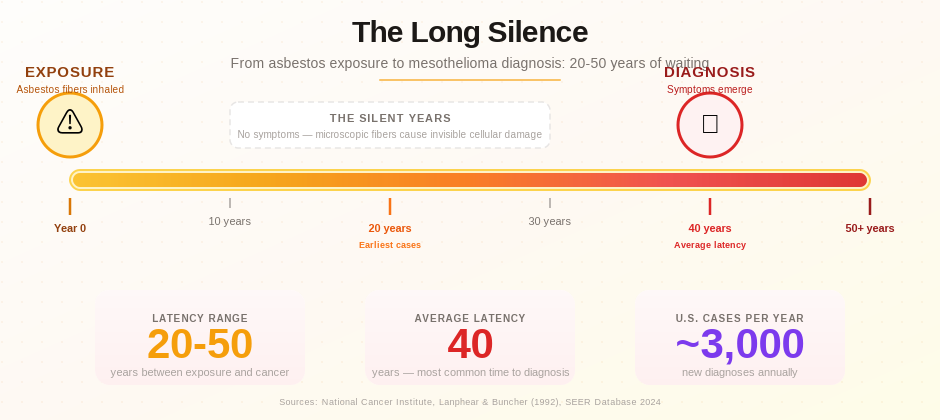
For most of the 20th century, asbestos was everywhere—insulation, roofing, brake pads, floor tiles, even some talcum powders. Companies knew it was dangerous. Internal documents from the 1930s show industry executives discussing the health risks. They used it anyway because it was cheap and incredibly effective as a heat-resistant material.
How Asbestos Damages the Body
The fibers are microscopic—invisible to the naked eye. When disturbed, they float in the air. Breathe them in, and they lodge deep in your lungs. Your body can't break them down or expel them. Over years and decades, they cause chronic inflammation, DNA damage, and eventually, in some people, cancer.
Not everyone exposed develops mesothelioma. But there's no safe level of exposure, and no way to predict who will get sick.
Who Was Exposed?
Some jobs were essentially a guarantee of asbestos exposure:
- Shipyard workers — Navy vessels were packed with asbestos insulation. Workers and sailors breathed it daily.
- Construction trades — Insulation installers, pipefitters, electricians, roofers. Anyone working in buildings before the 1980s likely encountered it.
- Industrial workers — Power plants, refineries, factories.
- Military veterans — Especially Navy, but all branches used asbestos in barracks, vehicles, and ships.
- Family members — Workers brought fibers home on their clothes. Wives who did laundry, children who hugged their fathers after work—secondary exposure is real and documented.
Symptoms: What to Watch For
Here's what makes early diagnosis so difficult: mesothelioma symptoms look like a dozen other conditions. Pneumonia. COPD. A bad flu. Most people—and many doctors—don't think "rare cancer" when they see these signs.
For pleural mesothelioma (lungs):
- Shortness of breath that gets progressively worse
- A dry, persistent cough
- Chest pain, especially when breathing deeply
- Unexplained weight loss—10+ pounds without trying
- Fatigue that doesn't improve with rest
For peritoneal mesothelioma (abdomen):
- Abdominal swelling or bloating
- Pain in the abdomen or pelvis
- Nausea, loss of appetite
- Bowel changes
The key question your doctor should ask: Were you ever exposed to asbestos? If you worked in construction, shipyards, automotive repair, or served in the military before the 1990s, mention it. That history changes everything about how your symptoms should be evaluated.
More on recognizing early warning signs.
Getting a Diagnosis
A mesothelioma diagnosis isn't straightforward. The disease is rare—around 3,000 cases per year in the U.S.—so many doctors have never seen it. Misdiagnosis as lung cancer, pneumonia, or even IBS (for peritoneal cases) is common.
The typical path:
- Imaging — Chest X-ray first, then CT scan if something looks off. A CT can show pleural thickening, fluid buildup, or masses.
- Fluid analysis — If there's fluid around the lungs (pleural effusion), doctors drain and test it. Sometimes this shows cancer cells, but not always.
- Biopsy — The only way to confirm mesothelioma. A tissue sample is examined under a microscope. The pathologist also determines the cell type (epithelioid, sarcomatoid, or biphasic), which affects treatment options and prognosis.
Important: If your biopsy results come back as mesothelioma, get them reviewed by a pathologist who specializes in this disease. Misclassification happens, and it matters—different cell types respond differently to treatment.
Full guide: How mesothelioma is diagnosed.
Treatment: What Actually Works
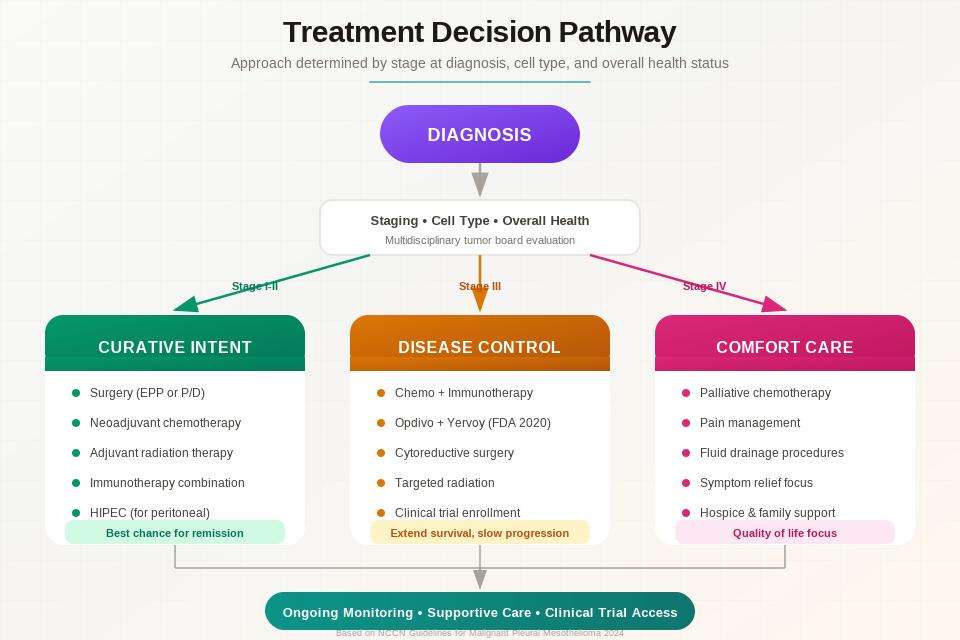
Treatment depends on stage, cell type, location, and how healthy you are overall. There's no one-size-fits-all approach—and honestly, finding a doctor who treats mesothelioma regularly (not just occasionally) makes a real difference in outcomes.
Surgery
If the cancer is caught early enough and hasn't spread too far, surgery can extend survival significantly. Two main options for pleural mesothelioma:
- Pleurectomy/Decortication (P/D) — Removes the diseased lining but keeps the lung. Less radical, faster recovery.
- Extrapleural Pneumonectomy (EPP) — Removes the lung entirely, along with surrounding tissue. More aggressive, longer recovery, but can be effective for certain patients.
For peritoneal mesothelioma, cytoreductive surgery combined with heated chemotherapy (HIPEC) has dramatically improved outcomes at specialized centers.
Chemotherapy
The standard combination—pemetrexed plus cisplatin—has been the go-to since 2003, when a major trial showed it extended median survival from 9.3 to 12.1 months (Vogelzang et al.). Not a cure, but it can shrink tumors and buy time.
Immunotherapy
This is where real progress has happened recently. In 2020, the FDA approved nivolumab plus ipilimumab (brand names Opdivo and Yervoy) for unresectable mesothelioma after the CheckMate 743 trial showed median survival of 18.1 months versus 14.1 months with chemo alone. Some patients respond exceptionally well—we're talking years, not months.
Radiation
Usually used after surgery to kill remaining cancer cells, or for pain relief when surgery isn't an option. Rarely a standalone treatment.
Detailed breakdown: All treatment options explained.
Prognosis: The Numbers and the Reality
The statistics are sobering. Overall 5-year survival is around 12% according to SEER data. But those numbers include everyone—people diagnosed at stage 4, people who couldn't tolerate treatment, people diagnosed decades ago with fewer options.
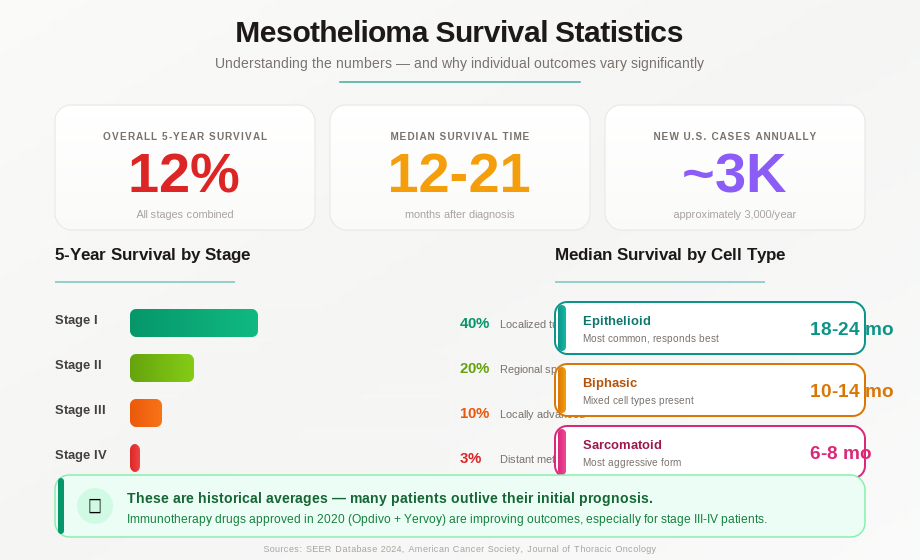
What actually affects survival:
- Stage at diagnosis. Stage 1 patients who can have surgery see dramatically better outcomes—some studies report 5-year survival above 40%.
- Cell type. Epithelioid mesothelioma responds better to treatment than sarcomatoid. If your pathology report says epithelioid, that's relatively good news.
- Location. Peritoneal mesothelioma patients treated with HIPEC at experienced centers often live years longer than pleural patients.
- Overall health. Can you tolerate surgery? Aggressive chemo? That determines which treatments are even options.
The prognosis conversation is hard. But it's worth knowing that survival statistics are backward-looking—they reflect treatments from years ago. Patients starting immunotherapy today have options that didn't exist when those statistics were gathered.
More detail: Understanding mesothelioma prognosis.
Common Questions
Is mesothelioma always caused by asbestos?
Almost always. About 80% of cases have a clear asbestos link (Carbone et al., 2012). The remaining cases involve radiation exposure, a genetic mutation called BAP1, or exposure to erionite (a mineral found in some volcanic rock). But if you have mesothelioma, asbestos exposure is the most likely explanation—even if you don't remember when or where it happened.
Why does it take so long to develop?
Nobody fully understands why the latency is so extreme—20 to 50 years between exposure and diagnosis. The fibers lodge in tissue and cause slow, cumulative damage over decades. This is why many patients getting diagnosed now were exposed in the 1970s or earlier, often in jobs where nobody warned them about the risks.
Is there a cure?
Not yet. But "no cure" doesn't mean "no hope." Some patients live years beyond their initial prognosis with the right combination of surgery, chemo, and immunotherapy. A handful of long-term survivors are 10+ years out from diagnosis. The goal is usually to control the disease for as long as possible while maintaining quality of life.
What's the typical life expectancy?
Median survival—meaning half live longer, half shorter—is roughly 12-21 months. But that number hides a lot of variation. Stage 1 patients who can have surgery do much better. So do patients with epithelioid cell type. Someone diagnosed late with sarcomatoid mesothelioma faces a very different prognosis than someone caught early with epithelioid. The averages don't tell individual stories.
Can family members get mesothelioma from a worker's exposure?
Yes. It's called secondary or secondhand exposure. Workers came home with asbestos dust on their clothes and hair. Wives who did laundry, kids who hugged their parents—some of them developed mesothelioma decades later. There are documented cases of women dying from mesothelioma whose only exposure was washing their husband's work clothes in the 1960s.
Where to Go From Here
Depending on where you are in this process:
Just Diagnosed?
Start with our newly diagnosed guide. Then look into finding a specialist — mesothelioma is rare enough that expertise matters enormously.
Researching Treatment?
Our treatment guide covers surgery, chemo, immunotherapy, and clinical trials. Consider getting a second opinion from a mesothelioma center.
Veteran or Family of a Veteran?
Military asbestos exposure was widespread. See our veterans guide and VA benefits walkthrough.
Looking Into Compensation?
Companies knew asbestos was dangerous. If you or a family member was exposed, legal options and trust funds may be available.


